I am posting the following 'Opinion Piece' without commentary, the article speaks for itself.
by Hacı Mehmet Boyraz Jul 23, 2024 - 12:05 am GMT+3
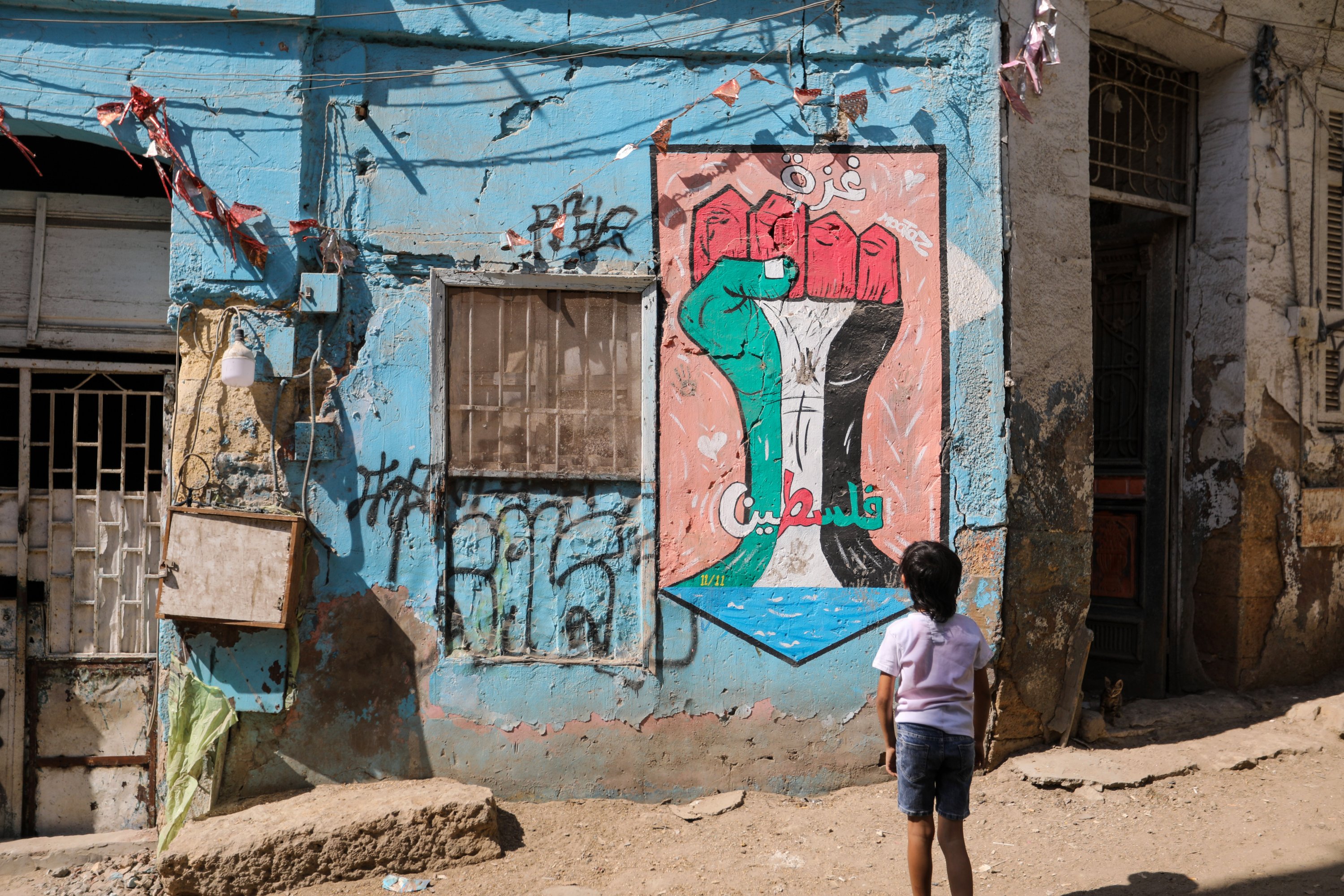
"Murals in the Darb al-Ahmar area show support for the Palestinians due
to the ongoing war in the Gaza Strip, Cairo, Egypt, July 17, 2024.
(Getty Images)"
"Israel's brutal assault on Gaza has resulted in 36,000 deaths and
displaced 1.7 million people; while the world remains silent, Türkiye
leads in aid and advocacy"
"The genocide that Israel started in Gaza on Oct. 7, and spread to Rafah
as of last week, continues brutally. More than 38,000 Palestinians,
15,000 of them children and 10,000 women, have lost their lives due to
the massacres against civilians, which clearly aims at destroying the
Palestinian society and moving to a new stage in the great Israeli
project. More than 80,000 Palestinians became veterans as well.
Additionally, according to estimates by the United Nations Population
Fund, 1.7 million Palestinians – approximately 80% of the country’s
population – have been internally displaced. Therefore, there is a
terrible humanitarian crisis in Gaza.
The hypocritical Western world, which claims to be the cradle of
civilization, turns a blind eye to the massacres as befits it. Sadly,
the Muslim-majority Middle Eastern countries have failed to unite in
support of Palestine. Consequently, the oppression in Palestine persists
because regional countries cannot find common ground among themselves.
Since Israel is aware of this reality, it has the audacity to bomb even
the people who have taken shelter in tent cities without hesitation.
Hence, the persecution in Palestine partly stems from the lack of unity,
akin to the Islamic principle of Tawhid, among the regional nations.
In honor of the late Ömer Tuğrul Inançer,
a prominent leader of the Cerrahi Sufi lodge, he frequently brought up
this issue in the programs he participated in throughout his life,
stressing that Muslims’ current state regarding Palestine is attributed
to their failure to adhere to unity and their lack of deep
contemplation. In essence, if the countries in the region had ceased
their conflicting approaches to Palestine and instead unified in thought
and action against oppression, Israel wouldn’t have been able to
oppress our brothers and sisters in Palestine for such an extended
period.
National interest concern
Why is it that the countries in the Middle East, often the first ones
we think of when considering the Islamic world, cannot unify on the
Palestinian issue, which directly impacts their security and future?
This question asked by many who are interested in the topic, has
numerous answers. In this article, we will touch on just one aspect. The
answer lies partly in the concept of national interest, where states
prioritize their own concerns. This concept, closely tied to realism in
international relations, which emphasizes power and security,
complicates the understanding of states’ foreign policy strategies and
decisions.
National interest, though its meaning varies depending on the context,
essentially suggests that each state must prioritize its own benefits in
a chaotic international setting and act accordingly. In the context of
our discussion, we observe that the countries in the region, while
largely maintaining their previous stances, shifted to prioritize their
national interests. Consequently, they struggle to present a unified
response to Israel, let alone address the ongoing crisis in Gaza.
Here, we must question how the silence surrounding the oppression in
Palestine aligns with the national interests of the countries in the
region. Some nations adopt a “see no evil, hear no evil, speak no evil”
approach, viewing Israel as not posing a threat to their security.
Others are preoccupied with internal issues and thus indifferent to the
Palestinian cause. Additionally, some countries opt for silence due to a
perceived lack of strength to confront Israel. Some of the countries in
the region are trying to ensure their national integrity or the
continuity of the political regime in the country without encountering
problems with Israel, the eye of the U.S. in the Middle East, which has
assumed the role of the world’s gendarmerie. They aim to strike a
delicate balance in their relations with Israel to prevent facing
situations like the recent American occupations in Afghanistan and Iraq.
Additionally, some nations rely on financial and military aid from
distant allies and thus act in ways that serve their interests, even if
it means disregarding the plight of Palestine. Overall, many countries
in the region prioritize their own self-interests when it comes to the
Palestinian issue.
Miscalculations
However, countries focusing solely on their own interests when
dealing with the Palestinian issue are overlooking its complexity
because it is crucial to recognize that Israel’s territorial ambitions,
rooted in Zionism, extend far beyond Palestine. The concept of the
"Promised Land" encompasses a vast area from the Nile to the Euphrates.
Thus, turning a blind eye or actively supporting Israel’s expansionist
agenda not only harms Palestinians but also jeopardizes the stability
and future of the entire region. It is akin to a prisoner sympathizing
with their captor.
It is important to remember that neighboring countries adopting a policy
of “letting the non-aggressive snake live” might eventually encounter
similar issues. Indeed, President Recep Tayyip Erdoğan, in a speech last
month, accurately pointed out this reality by stating that Hamas in
Gaza is conducting the front-line defense of Anatolia. The conclusion to
be drawn from this is that Erdoğan, foreseeing the threat to Türkiye
one day if Gaza were to be destroyed, equates the defense of these lands
with the defense of Anatolia.
Here I want to highlight our book titled “The Palestinian Issue and
Regional Actors” published last year. This book is relevant to our
current discussion. In it, we analyze the policies of various countries
on the Palestinian issue across a broad political landscape, spanning
from Morocco to Iraq, from the Gulf countries to Tunisia and from Iran
to Lebanon. The book, written with contributions from 13 authors, delves
into the subject from the perspectives of political science and
international relations. Our findings reveal that, except for Türkiye
and some others, most countries in the region are unable to unify on the
Palestinian issue due to prioritizing their own national interests.
This situation ultimately benefits Israel’s expansionist agenda. In
essence, the lack of unity among regional countries on the Palestinian
issue stems from their failure to prioritize common values over
self-interest.
Political leadership
It’s important to acknowledge the role of political leadership in the
failure of regional countries to unite on the Palestinian issue. The
personal attitudes of political leaders, who heavily influence the
foreign policy of their respective states due to their positions and
responsibilities, also impact the stance on Palestine. For instance, a
select few leaders, such as President Erdoğan, demonstrate a supportive
stance and actively work to alleviate Palestinians suffering under
Israeli oppression. Since his notable “One Minute” speech against
Israeli President Shimon Peres in 2009, Erdoğan has been perceived by
Palestinians as a champion of their cause, striving to garner global
support. I personally witnessed this sentiment during my visit to
Al-Quds and other Palestinian cities in the near past. However, unlike
Erdoğan a significant number of political leaders of the countries in
the region choose to remain silent, prioritizing either their country’s
relative interests or their personal political future.
To bring an end to the oppression in Palestine, it is essential for the
countries in the region to recognize that Israel poses as much of a
threat to themselves and the Islamic world as it does to Palestine. This
requires a shift in mindset from individual concerns to collective
unity. Without this collective consciousness, any proposed solutions
would be futile. Additionally, countries in the region must transcend
selfish and materialistic tendencies, such as prioritizing national
interests, and come together in solidarity against the common adversary,
particularly regarding Palestine. Put simply, the oppression in
Palestine will persist unless countries in the region overcome internal
divisions and adopt a unified stance rooted in the principles of
monotheism. This necessity is emphasized in verse 46 of Surah Al-Anfal
in the Quran, which urges believers not to dispute among themselves,
lest they become weakened. Therefore, Muslim-majority countries have no
alternative but to unite against the shared adversary.
Türkiye's unique stance
In addition to the points previously discussed, Türkiye continues to
assert itself as the country in the region with the most resolute and
accurate stance on Palestine, both before and after Oct. 7. This
position is grounded in Türkiye’s historical responsibilities in the
region, as well as its significant human and military capabilities. Even
when considering events from Oct. 7 onward, Türkiye has consistently
maintained that Israel’s actions in Gaza cannot be justified as
self-defense, but rather constitute blatant acts of genocide rather than
mere reactions to preceding events. Consequently, Türkiye has
steadfastly stood by the Palestinian people in opposition to Israeli
oppression from the outset, bolstered by strong support from its own
populace.
An important point to highlight is that Türkiye not only speaks the
truth about Palestine but also actively follows through on its words. At
this juncture, when considering Türkiye’s efforts for Palestine, we can
categorize them into six main areas. First, since Oct. 7, Türkiye has
been actively engaged in diplomatic initiatives aimed at resolving the
conflicts between the parties involved. Within this framework, Ankara
proposed a new solution model, advocating for Türkiye to serve as one of
the guarantor countries, with the goal of establishing lasting peace in
the region through a two-state political structure. However, the
Netanyahu administration, driven by its determination to perpetrate
violence in Gaza, rejected Türkiye’s proposal.
Second, Türkiye has consistently addressed the pressing needs of the
Palestinian people, who constantly face the stark reality of
life-threatening situations under Israeli attacks. In fact, Türkiye has
demonstrated significant generosity by being one of the top two
countries providing aid to Gaza since Oct. 7. According to data from
COGAT, around 25% of the humanitarian assistance reaching Gaza during
this period originated from Türkiye.
Third, Türkiye facilitated the evacuation of some injured
Palestinians from Gaza for medical treatment, despite the harsh Israeli
blockade, thereby giving them a chance to survive.
Fourth, Türkiye actively intervened in the genocide case initiated by
the Republic of South Africa against Israel at the International
Criminal Court (ICC). It also shared all available evidence with the
court to substantiate the allegations of genocide in Gaza, thereby
lending support to the global legal campaign against Israel.
Fifth, Türkiye’s lobbying efforts resulted in four European countries
recognizing Palestine as a state last month. This further solidified
the global anti-Israel coalition, in which Türkiye plays a significant
role.
Sixth, Türkiye maintained a consistent stance by suspending its
commercial relations with Israel, despite significant trade volumes –
$5.4 billion in exports and $1.6 billion in imports according to last
year’s data. In summary, Türkiye distinguishes itself from other
regional actors by approaching the Palestinian issue without
prioritizing national interests and by taking responsibility regardless
of its power.
It is important to recognize the significant efforts of the Turkish
media, which has remained steadfast in their national and humanitarian
values. They have diligently worked to shed light on the atrocities in
Gaza, preventing the suppression of truth. Israel’s disinformation
campaign is steadily losing credibility, thanks to the truthful coverage
provided by mainstream Turkish media. This stands as a challenge to
Western media, which seems to have lost its moral compass. Similarly,
Turkish society isn't indifferent to Israeli oppression today, as it was
yesterday, and shows extremely close interest in the issue. Thanks to
ongoing campaigns led by nongovernmental organizations (NGOs) with
Islamic and humanitarian sensitivities, Turkish society is challenging
Israeli oppression by stubbornly continuing civil protests and boycotts."
https://www.dailysabah.com/opinion/op-ed/regional-actors-lack-of-unity-on-the-palestinian-issue
Thank you for sharing this blog with friends and family. You are helping to overcome the deafening silence from the commercial media on most topics, they just don't want us to know about.
This blog is not monetized, it is strictly produced as a public service.




%20%E2%80%94%20Scaled%20(47%25).png)